The NRL1 Form Explained
03 Nov 2026
The NRL1 Form Explained: How Overseas Landlords Can Protect Their Rental Cash Flow
Relocating overseas, taking an expat posting, or building a UK buy-to-let portfolio from sunny climates sounds idyllic.
HMRC handles overseas landlords very differently than domestic property owners.
Under HMRC’s Non-Resident Landlord Scheme (NRLS), the standard rule is that your letting agent or tenant, if you self-manage, is legally required to withhold 20% basic-rate income tax from your rent before forwarding what is left to your overseas account.
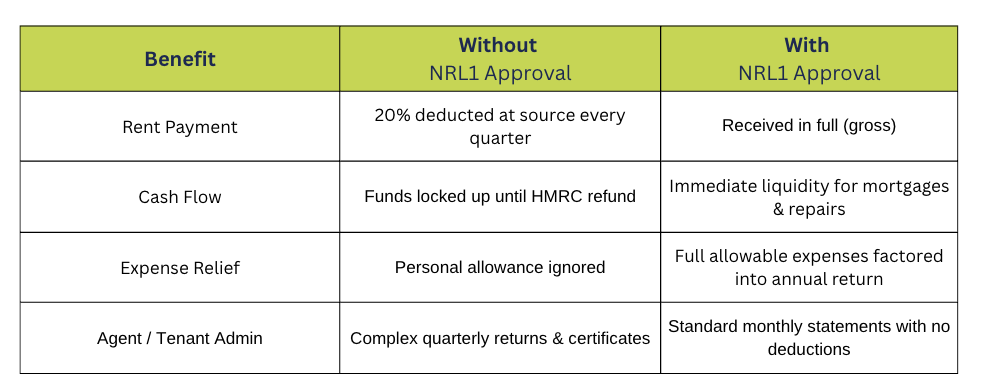
Having 20% of your gross rental income sliced off each month causes immediate cash flow friction. Fortunately, you don’t have to settle for automatic deductions. By submitting an NRL1 form, you can apply to receive your rental income gross and handle your tax obligations yourself through an annual Self Assessment tax return.
Here is everything you need to know about the NRL1 form, how the scheme works, and how to get your application approved.
What is the Non-Resident Landlord Scheme (NRLS)?
Introduced in 1996, the Non-Resident Landlord Scheme ensures the UK government collects tax on income generated from British property before the funds leave the country.
Unless HMRC sends an official exemption letter, the default rules mandate that:
- Your Letting Agent must calculate and deduct 20% tax (after allowable agency expenses) and remit it directly to HMRC each quarter.
- Your Tenant must deduct 20% tax if you self-manage without an agent and the rent exceeds £100 per week.
The downside to this default setup is obvious, cash flow. The withholding calculation does not account for personal tax allowances, mortgage interest relief, or wider operational costs like landlord insurance and maintenance. The NRL1 form is your official mechanism to opt out of deduction at source.
What Exactly is the NRL1 Form?
The NRL1 is an official HMRC application form for individual non-resident landlords. When approved, HMRC issues a formal certificate allowing your letting agent (or tenant) to release 100% of your rental payments without deducting tax.
Key takeaway: The NRL1 form is not a tax exemption. You are still legally obligated to pay UK income tax on your net rental profits. It simply grants you permission to pay your bill directly to HMRC via your annual Self Assessment rather than having money skimmed off every payment cycle.
(Note: The standard NRL1 applies to individuals. If your property portfolio is owned through a limited company or a trust, you will need the NRL2 or NRL3 form respectively).
Who Qualifies as a Non-Resident Landlord?
HMRC does not determine your status for this scheme based purely on your statutory tax residency or citizenship. Instead, it looks at your "usual place of abode".
You generally fall under the NRLS if:
- You live or intend to live outside the UK for 6 months or more in a tax year.
- You are an expat, digital nomad, or member of the British Armed Forces / Crown Service stationed overseas.
- You are a foreign national who owns income generating property within England, Wales, Scotland, or Northern Ireland.
If you and your spouse or business partner co-own a rental property, both of you must submit separate NRL1 forms for your respective shares of the income. A single application does not cover both owners.
Why Should Landlords Complete the NRL1 Form?
- Immediate Cash Flow Control
Receiving full rental payments provides the liquidity needed to service buy-to-let mortgages, fund unexpected repairs, and handle tenant changeovers without dipping into personal reserves. - Fair Accounting of Expenses
Withholding tax takes a blunt 20% cut. Settling through Self Assessment allows you to offset legitimate allowable expenses, letting fees, safety certifications (Gas Safety, EICR, EPC), council tax, and accountancy charges ensuring you only pay tax on your profit. - Streamlined Relationship with Letting Agents
Operating under default withholding creates unnecessary administration. Letting agents must file quarterly returns and year-end certificates with HMRC. Once your NRL1 approval is linked to your agent's account, monthly payouts run seamlessly.
When and How to Apply for NRL1 Status
Submit your application as early as possible ideally as soon as you confirm you will be abroad for six months or more, and before your tenancy starts.
HMRC typically takes 2 to 8 weeks to process the application. Once approved, the notice usually applies from the start of the quarter in which HMRC received your form. Crucially, your letting agent cannot legally pay you gross until they receive formal written authorization directly from HMRC.
Step-by-Step Application Process
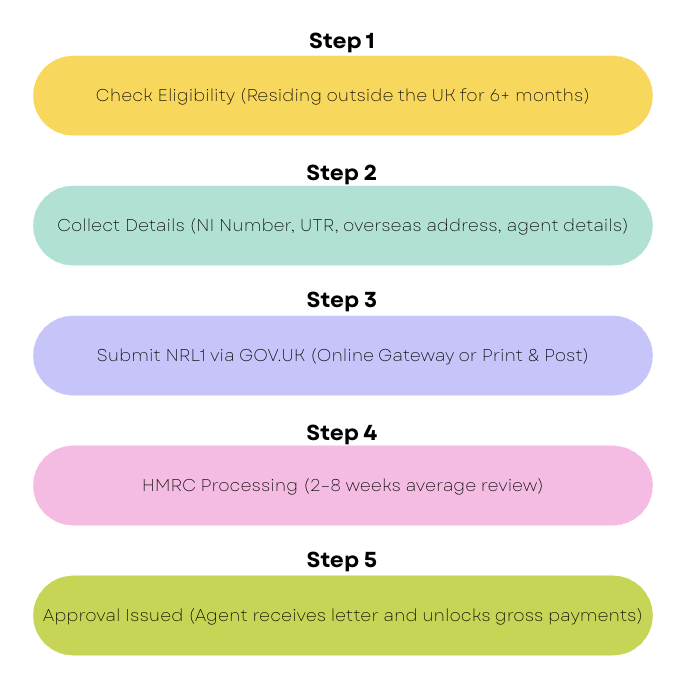
- Gather Required Details: You will need your National Insurance Number, Unique Taxpayer Reference (UTR) if you already have one, your current international residential address, and your UK property address.
- Include Letting Agent Info: Provide your letting agency’s full registered name, address, and their HMRC NRL reference number. This ensures HMRC dispatches the confirmation letter directly to their property management team.
- Choose Submission Method:
- Online (Fastest): Sign in via your GOV.UK Government Gateway credentials to submit electronically.
- Print and Post: Fill out the interactive PDF on GOV.UK, print it, sign it physically, and post it to HMRC's Non-Resident Landlords department. (Note: If you want an accountant or tax agent to apply on your behalf, you must also submit Form 64-8).
- Notify Your Property Manager: Keep your letting agent in the loop so they can look out for the notification from HMRC and switch your account to gross payout status immediately upon receipt.
Receiving your rent gross comes with responsibility. HMRC grants NRL1 approval on the condition that you keep your UK tax affairs up to date.
- Register for Self Assessment: You must submit an annual UK Self Assessment tax return declaring your rental profit by 31 January following the end of the tax year.
- Keep Impeccable Records: Retain every invoice, digital letting statement, and receipt for property maintenance and repairs.
- Update HMRC if Circumstances Change: If you move back to the UK full-time or switch letting agents, notify HMRC promptly so records remain accurate.
Need Help Managing Your UK Property from Abroad?
Looking after a rental property while living thousands of miles away doesn't have to be stressful. From finding vetted, reliable tenants to coordinating routine maintenance and ensuring complete statutory compliance, a dedicated letting agent handles the day-to-day operations so you can focus on life abroad.
Have questions about managing your rental income or need a compliant managing agent to use whilst living abroad?
Drop our Client Manager, Jake a message on jake.astill@ultralets.co.uk.
PLEASE NOTE: This blog does not constitute financial advice and is for educational purposes only. Seek professional advice should you require financial help.

Rated 5 stars on Google
by our customers

Talk to an Ultralets
team member